
Through poetry this book provides insightful reflections on the attributes of and imperative for human decency in one’s personal life and in the process of national development. Focusing on Liberia, the book illuminates aspects of the country’s history, particularly its war and postwar situation as well as the challenges for development. The book further advocates the need for patriotism, peace, knowledge, integrity and capacity building while conveying a message that development should not be regarded solely by the level of material wealth, but also by how it touches human life and whether it protects or undermines the dignity of people.
“Anthony Barclay possesses the acumen of scholarly wisdom from a historian’s perspective along with the morality of a pontiff and the gentleness of a tutor. He imprints his messages with an entertaining style and respect for his audience. One learns the riches of his beloved Liberia, the wonders of its landscapes and the humanity of its people. With atrocities of the past behind, he shows that we are given the gift of the future, and like a signpost, Anthony Barclay self designates his need to guide his people through the pain and towards peace. This book should be a permanent reference in all school libraries, accessible to all who wish to gain Personal Human Decency from the University of Life, whilst enjoying the cleverness of Barclay wordsmithing.”
– Nicole Sorkin, Managing Book Review Editor. Pacific Book Review, Nipomo, CA, USA

Insights from selected Liberian Independence Day Orations pertinent to the historical development of the Republic of Liberia and its challenges and opportunities This book provides a one – stop source of literary resource gleaned from a number of Liberian Independence Day Orations that span selected years interspersed over the period 1855 – 2000. The orations may serve as a source for scholarly inquiry as they cover multiple themes that are germane to the evolution of the country. In general, the orators provide important contextual information and varied insights and perspectives about the country’s social, political and economic development. For example, the orations address the historical and current challenges of nation-building in general. More specifically, they illuminate such issues as: (i) Liberia’s survival as a small state surrounded by Western colonial powers; (ii) challenges and opportunities in the quest for social integration and economic development; (iii) the centrality of education, agriculture, trade, commerce, industry, other sectors and related factors for development, as well as the role of women and the youth in the development process. They also include perspectives on the inclusion of the masses and freedom of the press in the nation-building process, overarching governance issues and the post-civil war challenges for recovery and aspirations for the future.
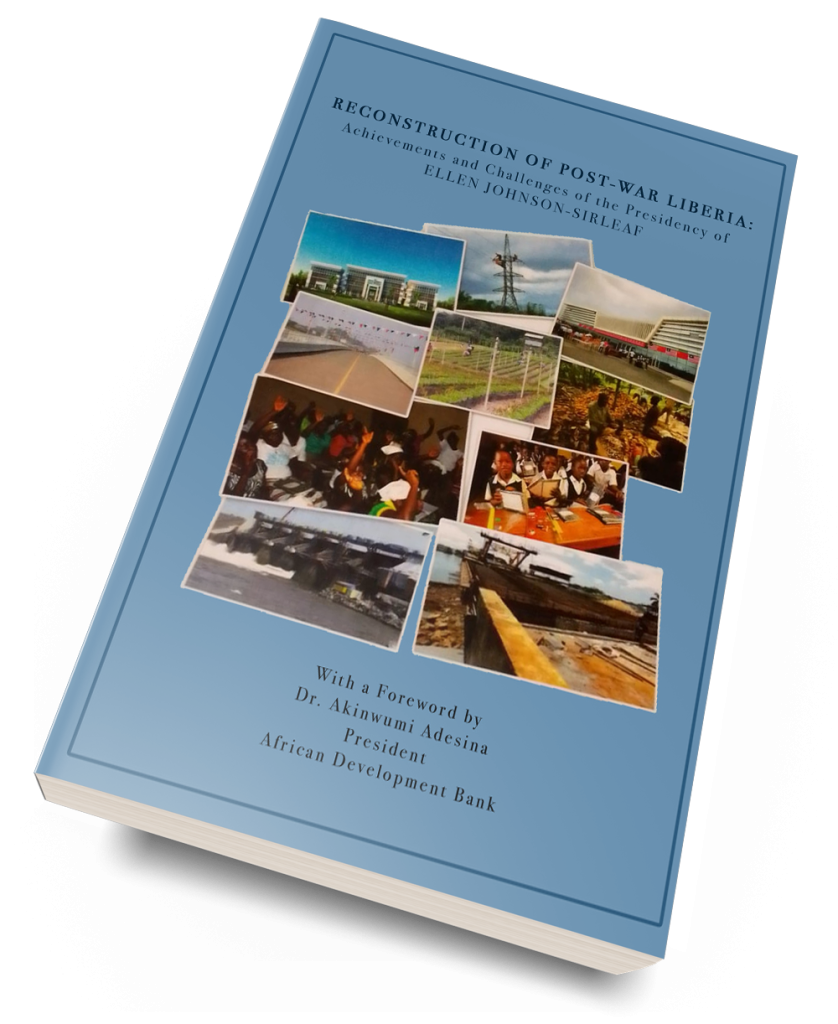
The EJS Center is pleased to announce the release of the book: ‘The Reconstruction of Post-War Liberia: Achievements and Challenges of the Presidency of Ellen Johnson Sirleaf.’ This book, a product of the Ellen Johnson Sirleaf Legacy Project, co-edited by Anthony Barclay and Miata Beysolow, is the second in a two-volume series. The series documents milestones and setbacks during former President Sirleaf’s tenure as the first democratically elected female president of the Republic of Liberia following fourteen devastating years of civil war.
Volume I consisted of selected speeches from her presidency and was launched in January 2018, shortly before the mantle of leadership was passed on to then incoming President H.E. George Manneh Weah. The project was funded by the African Development Bank (AfDB), in partnership with the Angie Brooks International Center for Women’s Empowerment, Leadership Development, International Peace and Security (ABIC), the Governance Commission (GC), and the EJS Center.
Volume II was launched in November 2021 during an event that featured observations from Madam Sirleaf, former Vice President of Liberia H.E. Joseph N. Boakai, and other distinguished guests, including current members of Government and funder organizations. The event also included a presentation of the book, insights into the President’s Legacy Project, and an interactive session with the audience.
Co-edited by Anthony Barclay and Miata Beysolow, Volume II takes the reader on a journey of discovery of the reconciliation, governance, and economic reconstruction endeavors undertaken by Madam Sirleaf’s administration during Liberia’s post-war recovery.
The book is organized into four sections covering the following themes: Peace, Democracy, Security, and Stability; Economic Recovery, Growth, and Development; Women Empowerment and Leadership in Conflict Resolution/Management, Youth Development, and Social Protection; and a concluding section that narrates Madam Sirleaf’s personal thoughts on her 12-year presidency.
“The book provides real-life examples of leadership qualities that are needed to ensure Africa’s political and economic transformation. I have often spoken of effective leadership as the ability to set attainable vision to inspire others and to govern selflessly. This book highlights examples after example of just these things”
– Dr. K. Y. Amoako, Founder and President of the African Center for Economic Transformation and former Executive Secretary, UN Economic Commission for Africa
AVAILABLE AT: www.ejscenter.org. Coming soon at Amazon
This book presents poetry, which the author believes is another suitable medium of scholarship for expressing his views on Liberia’s development. He says that studying poetry, evaluating its messages, and embracing them within relevant contexts can be helpful to Liberians to empathize with and support each other rather than engaging in acts of violence and destruction. The poems cover some of the salient issues of Liberia’s developmental process, highlighting the conditions of progress, stagnation, and regression. The lyrics, figuratively in some poems and literally in others, express the author’s sentiments and hopes for positive change now and in the future for Liberia. . It also includes lyrics with philosophical and social overtones regarding family and friends.
“Dr. Anthony Barclay, in this anthology entitled “Coming Together: The Ins and Outs of Liberia’s Ups and Downs” produced nothing short of a masterpiece, of not only a literary work, but also what positions him as a Development Poet of the highest order, and a passionate one at that. The title of many of the poems and his introductory section speak to this, thereby justifying such appellation from one who herself worked in international development for some twenty-five years. Most of the poems exude patriotism, nationalism, calling on Liberians to rise to the task of nation-building and reminding them that we are all Liberians -no matter the past, and that we are all obliged to do our part to develop our country. This book belongs, foremost, to the Liberian educational system. It is excellent material for educating the Liberian citizenry, at all levels of society, and the youth, as well as all branches of the Liberian government. I believe that all readers who take the time to go through this book will appreciate the messages it conveys. Not only did the expressed passion and inspiration move me to tears, but upon reflection, could one expect anything less from a close relative of former President Edwin J. Barclay, author of the “Lone Star Forever” (Liberia’s foremost patriotic song), which urges Liberians to “Uphold the Lone Star forever and desert it no never! Anthony, I salute you!”
– Olubanke King-Akerele, Former Minister of Foreign Affairs, RL

The poems in this book reflect some of what Dr. Barclay has acquired in his journey of self-discovery of the vicissitudes of life. They poetically articulate his emotions, concerns and insights on several topical issues, situated historically, socially and intellectually. Most of the poems deal with his experience during the Liberian civil crisis. The rest deals with family, friends, love relationships and philosophical views of other aspects of life in general. He says that the poems were written basically from his heart, a heart that feels the pain, sorrow, disappointment and disgust of the death, barbarity, devastation and deprivation caused by the Liberian civil war; they were written from his mind, a mind that seeks understanding and empathy and envisions a better tomorrow; and they were written as a voice, a voice of a person simply speaking to another. While it is true that a poem rarely means the same thing to each person, he has tried to penetrate objective reality in some of the poems, conveying what he hopes are clear concepts and feelings. In others, he has deliberately left it to the reader’s imagination, experience, insights and feelings, through which one may derive unique interpretations and significance.
“Liberia in Thoughts and Plans and Other Poems treats complex issues through subtle expressions of feelings and imaginations that convey various aspects of reality Like other great works of poetry, Barclay’s poetic visions are subject to the interpretations of the reader.”
– Wokie M. Weah